CitiSignal - Family Account Optimization Campaign
Introduction

Audience: Marketers, Solution Architects, Developers.
Environment Details:
Demo Scenario
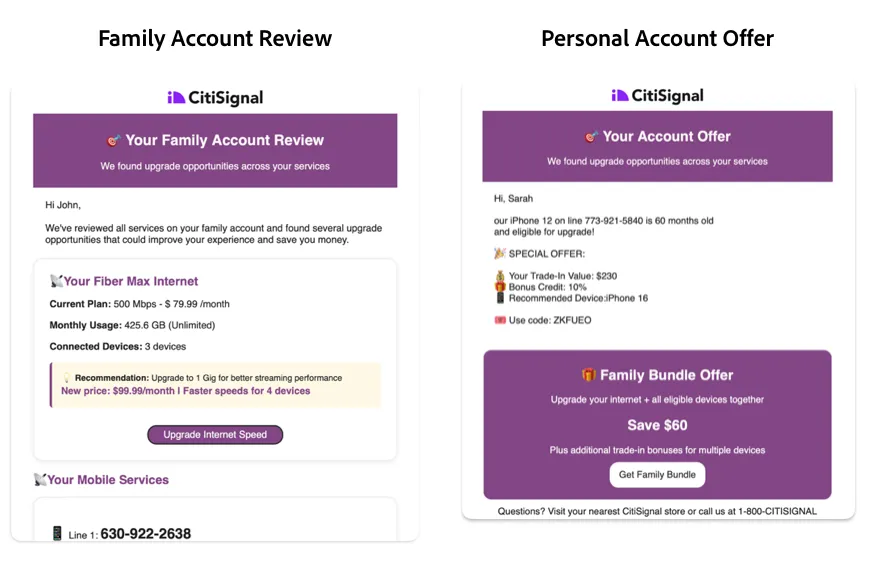
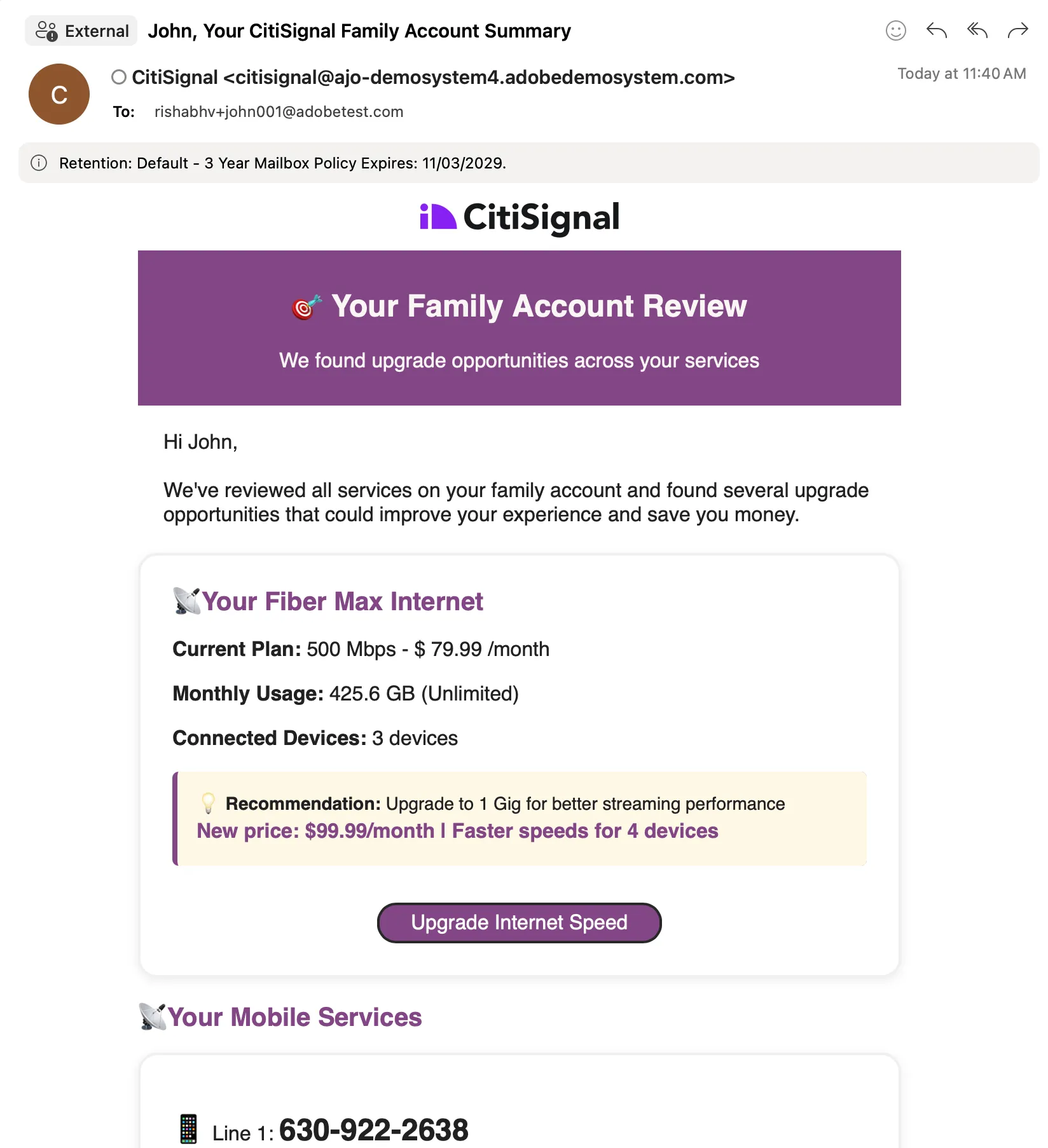
CitiSignal Family Account Optimisation Campaign John has a family account with 4 lines and Fiber Max. We send him ONE campaign showing optimisation opportunities for ALL entities he manages - which lines can upgrade devices, should he upgrade his internet speed, does he need better WiFi equipment.
Customers who enter the campaign are evaluated for account-level and subscription-level upgrade opportunities. The campaign splits into a treatment (90%) and control (10%) cohort. Treatment contacts receive enriched, personalised emails at two levels: (a) an account-level multi-entity email to account holders, and (b) one or more per-subscription device-upgrade emails to line users (and SMS where applicable). Control contacts are saved for later lift analysis.
Telco Data Model
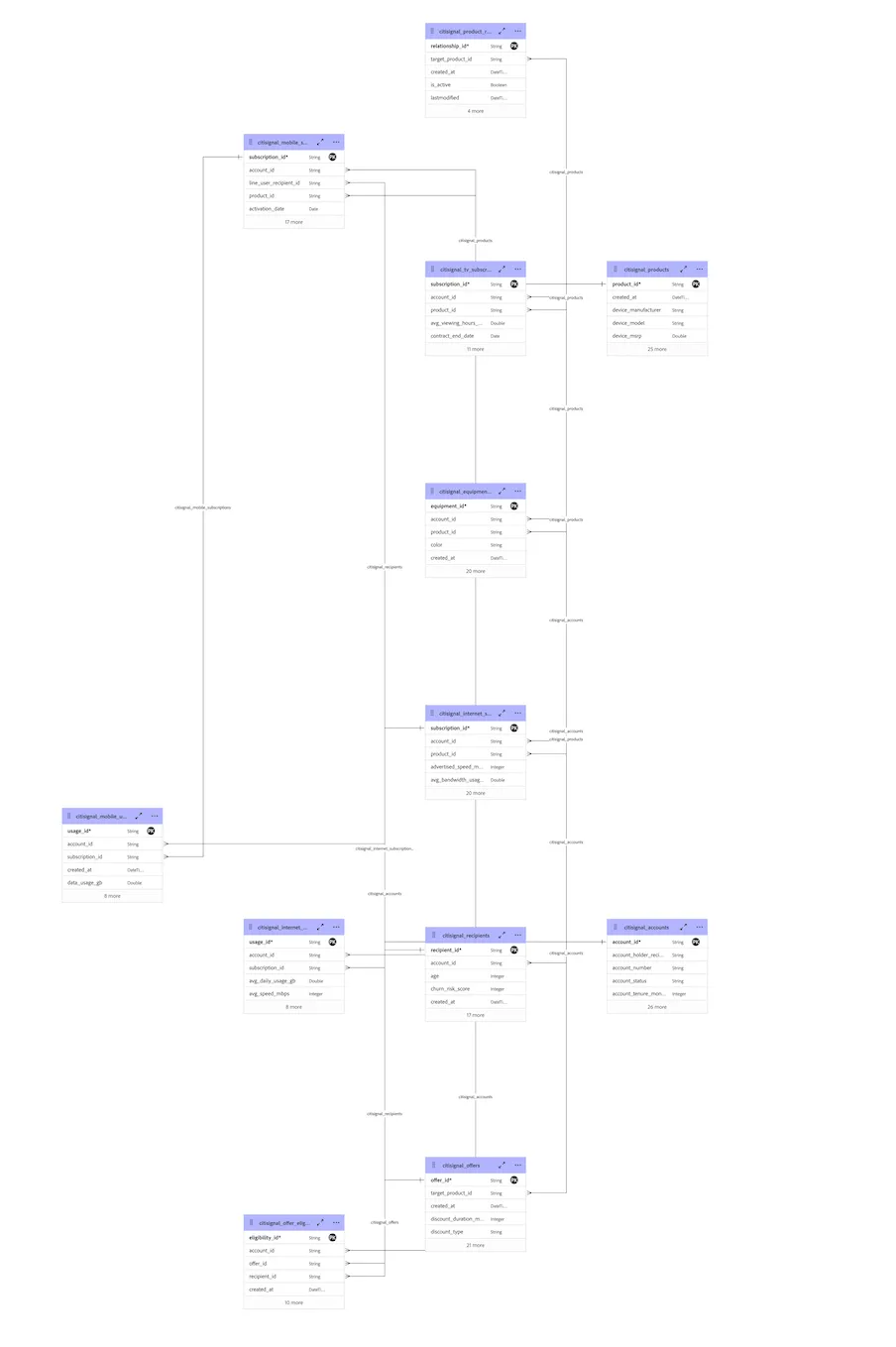
- Accounts form the core entity.
- Recipients represent users under accounts.
- Subscriptions (Mobile & Internet) represent services owned by accounts.
- Usage tables provide time-series service consumption data.
- Products act as a shared reference entity across subscriptions, equipment, and offers.
- Offers and Eligibility support targeted marketing and churn mitigation use cases.
- Product Relationships enable bundling and cross-sell logic.
Technical Enablement
In order to follow step by step creation of above campaign follow the link for technical enablement documentation.
Step‑by‑step breakdown of the campaign flow
STEP 1 — Campaign Entry
What triggers it: Campaign scheduled run with target dimension citisignal_recipients. Business intent: Begin evaluation of accounts for upgrade/cross-sell opportunities. Customer experience: No visible touchpoint yet — system accepts customer record into the campaign. Outcome to track: Total entrants accepted into the campaign.
STEP 2 — Primary Audience Query ("Account Holders with Opportunities")
What happens: System filters citisignal_recipients for account holders associated with active accounts and at least two mobile subscriptions. Business intent: Focus on family accounts (multi-line) that present higher cross-sell/upgrade value. Customer experience: Customers meeting criteria will continue down the campaign; others exit or are routed elsewhere. Expected business outcome: A refined cohort.
STEP 3 — Random Split (90% Treatment / 10% Control)
What happens: The filtered accounts are randomly divided into Treatment (90%) and Control (10%). Business intent: Maintain an untouched control group to measure incremental impact of campaign messaging. Customer experience: Control members receive no campaign messages from this run; treatment members proceed.
STEP 4 — Enrichment Chain (Treatment Path)
What happens: For treatment accounts, the campaign pulls account, internet subscription, mobile subscriptions (collection), device equipment, and router/equipment data. Business intent: Assemble data required to personalize messaging and determine upgrade eligibility and offer suitability. Customer experience: Invisible; their profile is augmented with attributes used in personalization (e.g., device age, trade-in value, eligible offers).
STEP 5 — Account-level Email ("Send Multi-Entity Account Review")
What happens: The campaign sends a personalized email to the account holder using enriched account and aggregated line data. Business intent: Present family-wide upgrade opportunities in a consolidated message to the account owner to drive higher-value conversions. Customer experience: Account holder receives an email summarizing internet, device, and line-level upgrade options. Outcome/KPIs: Email deliverability, open rate, CTR, and conversions tracked at account level; compare against control.
STEP 6 — Change Dimension: Account → Mobile Subscriptions
What happens: The campaign switches target dimension from citisignal_mobile_subscriptions (each phone line) to citisignal_recipients (account holders). Business intent: Evaluate each line independently to surface per-line upgrade opportunities and comply with per-subscription targeting requirements. Customer experience: If an account has multiple eligible lines, each line will be evaluated separately and may generate individual messages.
STEP 7 — Enrich Subscriptions with Recipient and Device Data
What happens: For each mobile subscription, the campaign:
- Joins back to citisignal_recipients (line-user) to fetch contact email/name.
- Enriches device details from equipment subscriptions.
- Fetches recommended product details (product catalog). Business intent: Ensure each subscription has the recipient contact and device/product context needed to craft a relevant single-line communication. Customer experience: Line users gain individual content (device-specific upgrades).
STEP 8 — Change Dimension: Mobile Subscriptions → Recipients
What happens: Campaign switches back to citisignal_recipients so messages can be delivered (Adobe requires target = recipients for sends). Business intent: Enable delivery to the recipient addresses associated with each subscription after per-line evaluation. Customer experience: Each eligible subscription results in one message addressed to the corresponding line user. Multiple eligible lines for one person will generate multiple messages.
STEP 9 — Per-subscription Email Send ("Send Device Upgrade Email Per Subscription")
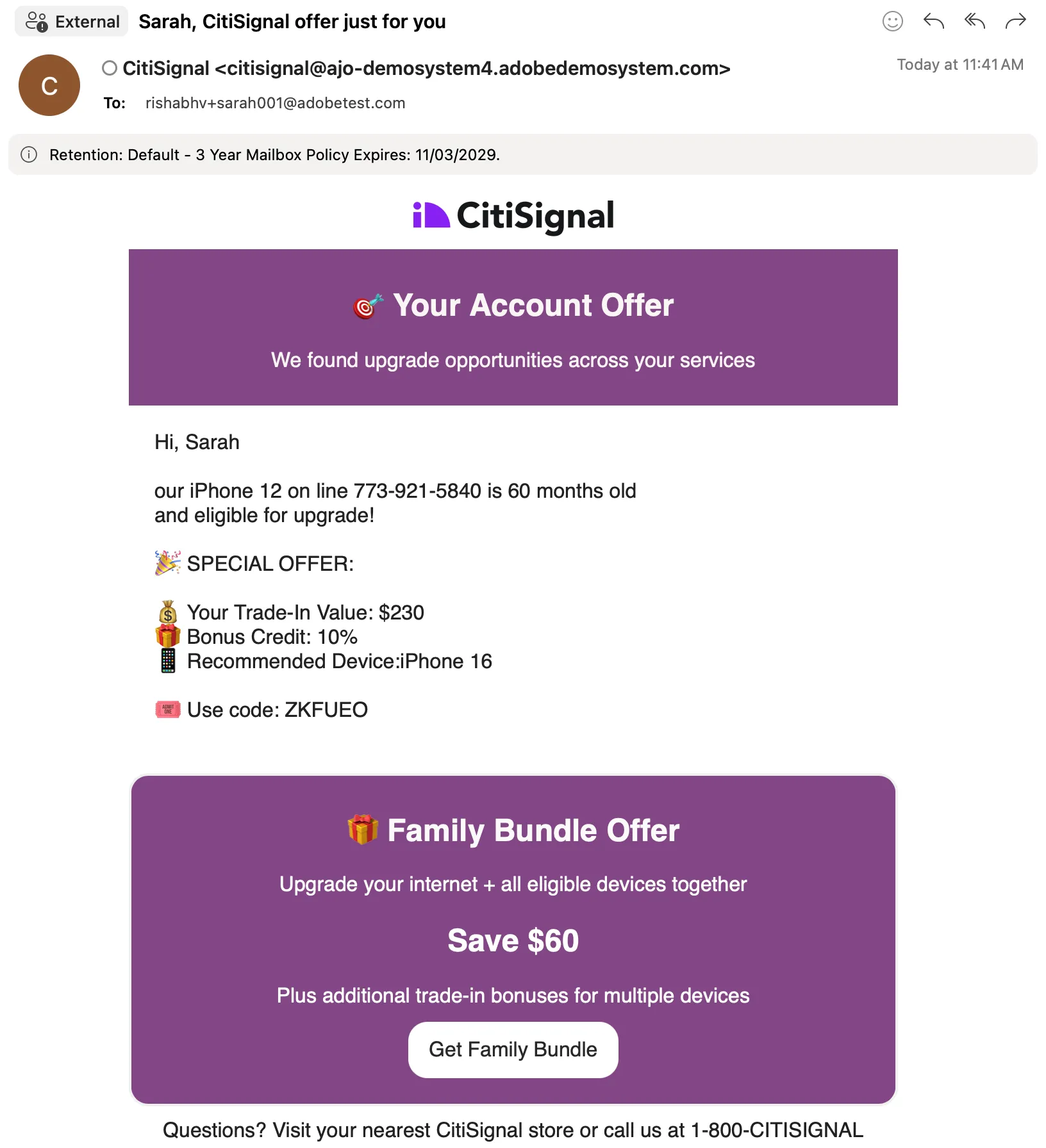
What happens: Send individual upgrade email for each eligible subscription using variables: phone number, device model, trade-in value, recommended product. Business intent: Drive conversion at the line level with specific CTAs (upgrade, trade-in, device purchase). Customer experience: Line user receives a short, actionable email specific to their phone number/device. If a user has 3 eligible lines, they will get 3 distinct emails (one per line). KPI: Per-subscription open rate, CTR, purchases, and incremental conversions attributed to the campaign.
Channel branching to SMS (if applicable)
What happens: After subscription evaluation, eligible subsets may be split and routed to SMS. Business intent: Use SMS for higher-urgency, high-value offers to improve response rates. Customer experience: Opted-in line users may receive a concise SMS CTA instead of or in addition to email.
Screenshots